Why Koinis?
The Enterprise Advantage: Engineered to elevate precision, safeguard cargo integrity, and systematically minimize unit costs across complex multi-modal supply corridors.
Unified Governance
Single master agreement eliminating cross-vendor friction and compliance liability.
Real-Time Control Tower
Continuous IoT sensor telemetry with live temperature and spatial GPS tracking.
Capital Elasticity
Convert rigid warehousing fixed capex into fluid, volume-tied operational scale.
The 6 Core Pillars of Why Koinis
Designed specifically to bridge high-assurance operational execution with enterprise digital agility across mission-critical networks.
Integrated Capability
Multiple logistics services under one operating partner.
Scalable Operations
Solutions designed to scale with customer volumes and geographical requirements.
Technology Enabled
Greater visibility through digital tracking, reporting and performance management.
Operational Expertise
Strong focus on execution, process discipline and continuous improvement.
Cost Optimisation
Data-driven approach to improving logistics productivity and controlling supply chain costs.
Customer Centricity
Solutions designed around each customer's business, service requirements and operating model.
How Operational Excellence Is Maintained in Practice
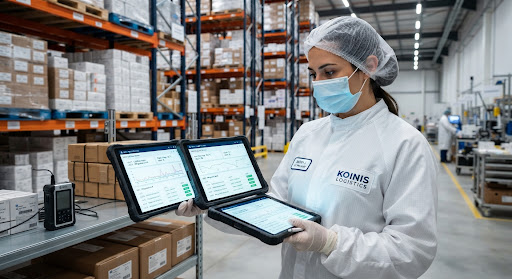
Every shipment entering our multi-tenant network passes through a zero-defect quality gate. We align warehouse management systems directly with calibrated handheld scanning terminals, environmental telemetry loggers, and customs declaration databases to remove human verification errors.
Our Performance Framework
We believe logistics performance should be measurable.
Our operations can be managed against agreed customer KPIs such as:
Measure. Improve. Repeat.
Continuous performance monitoring allows us to identify exceptions, address root causes and improve operational outcomes.
Ready to Upgrade Your Supply Chain Resilience?
Schedule an executive briefing with our lead GDP auditors and logistics architects. We will evaluate your current cost per unit, identify operational bottlenecks, and outline a zero-risk transition framework.